
Tilted Arc Revisited
Richard Serra’s Foley Federal Plaza installation reimagined by my mother

Mimi Weisbord was dreaming big in the late 70s when she moved from Brooklyn to SoHo. Five years after leaving my father, Manhattan was her fresh start, where she’d always wanted to be, among artists and galleries, and for a short time, she imagined the neighborhood’s brick facades as blank canvases. She was ready to take up space.
In “SoHo Walls Never Funded,” I shared some of her CityArts mural proposals. These exteriors, looming with vintage wallpaper patterns (copied from the walls of our Massachusetts country house), offered a feminine and feminist vision for a neighborhood that was, instead, soon taken over by Absolute Vodka bottle ads.
Around this same time, the minimalist sculptor Richard Serra installed a curving, rusted 120-foot-long steel wall that obstructed pedestrian traffic across Foley Federal Plaza and inspired lawsuits. Tilted Arc was taken down in 1989.
In her way, my mother tried to save it.
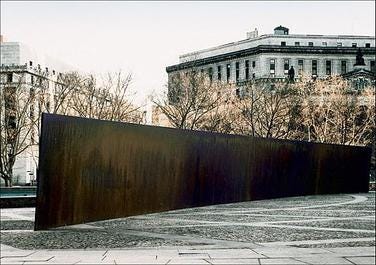
I recalled her final CityArts proposal last year when I came across art critic Carter Ratcliff’s essay, “Remember Tilted Arc?”. I dug around for it and looked again a few weeks later when obituaries for Richard Serra were all over the news. I had no luck and wrote a post, assuming it was lost or discarded.
Then, earlier this month, as I was sorting for our impending move to Portugal, I found her Tilted Arc in a box of works on paper.
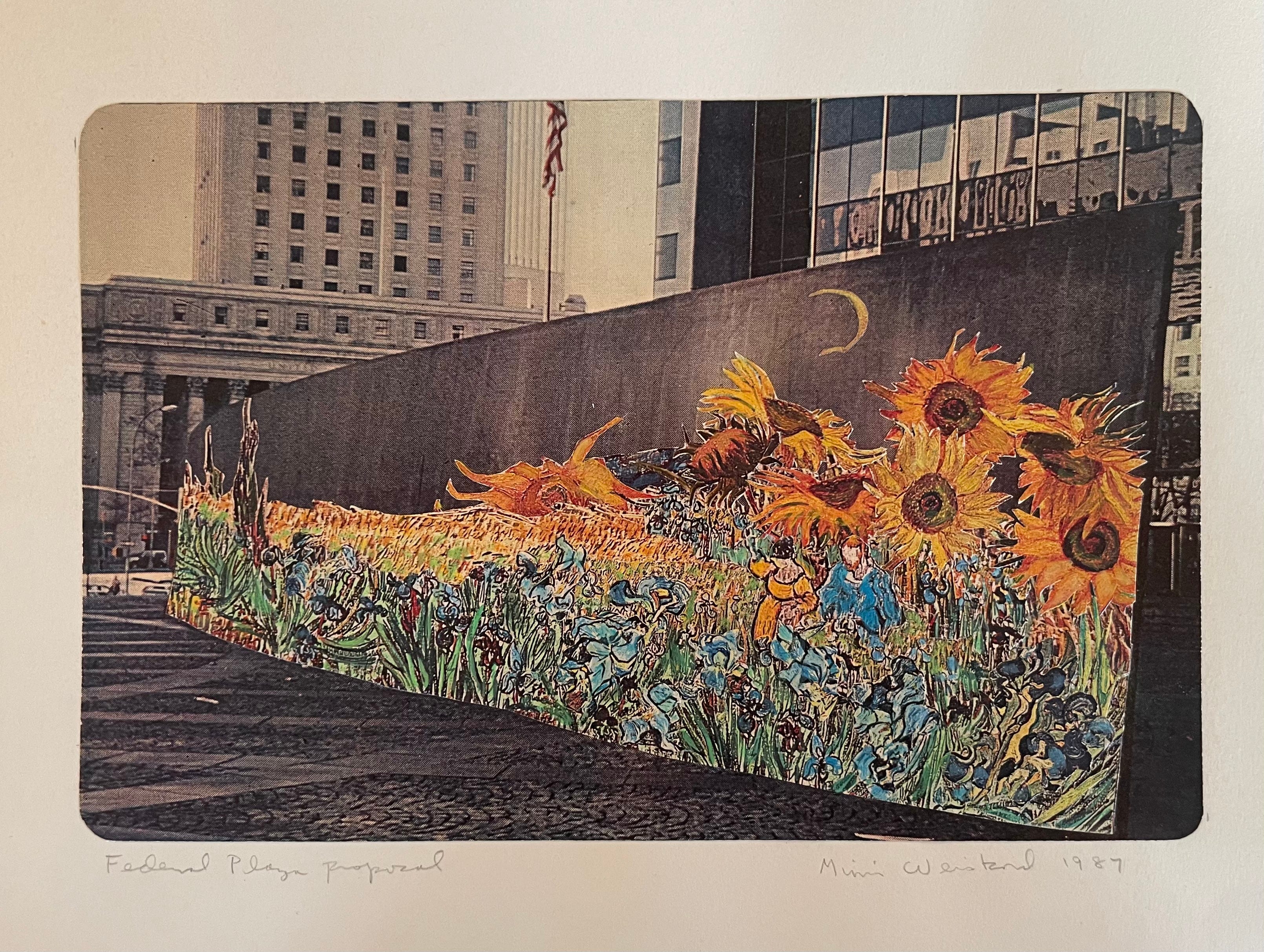
What a surprise this was. I didn’t remember it as a Van Gogh painting. I recalled only that she’d prettied up Serra’s sculpture with Van Gogh-inspired sunflowers. But here was Serra’s wall layered with Van Gogh’s abundance.
Surely she knew it had no chance at getting funded. A proposal to manhandle Serra and Van Gogh, why even try it? Maybe Tilted Arc was another blank wall she couldn’t resist? Here was an opportunity to transform an overwhelming rusted steel barrier into a confrontation with paint, color, and an overgrown natural landscape — a grand rejection of minimalism.
And, surely, a spit in the eye to Serra.
Which had me recalling how, in the mid-80s, she was metabolizing the painful end of her relationship with another minimalist sculptor working in that era.
But then the paper’s surface caught the light, and any sense of her hostility dissolved. I ran my fingers over those flowers, and was reminded that 1987 — the year she mocked up this concept — was before Photoshop, and before the internet, when paintings were found solely in books, museums, and on walls. In my hands were hours spent with an X-Acto knife trimming, positioning, layering, gluing down bits and pieces of Van Gogh, accommodating perspective with a care that, in 2025, takes on new meaning: devotion and the work of a quiet mind … a state I now seek for myself in a time of scrolling, image manipulation, and — god help us — AI. Saturated with digital content, I’d nearly missed it.
Yet, ironically, her construction seems to anticipate these digital tools and desires. She’s harvested sunflowers and irises from Van Gogh landscapes and vases, and nowhere in Van Gogh’s work do I find sunflowers towering above people (as Tilted Arc loomed above passersby on Federal Plaza). She’s crafted her own Van Gogh dreamscape.
Searching Van Gogh images did find me this, however:
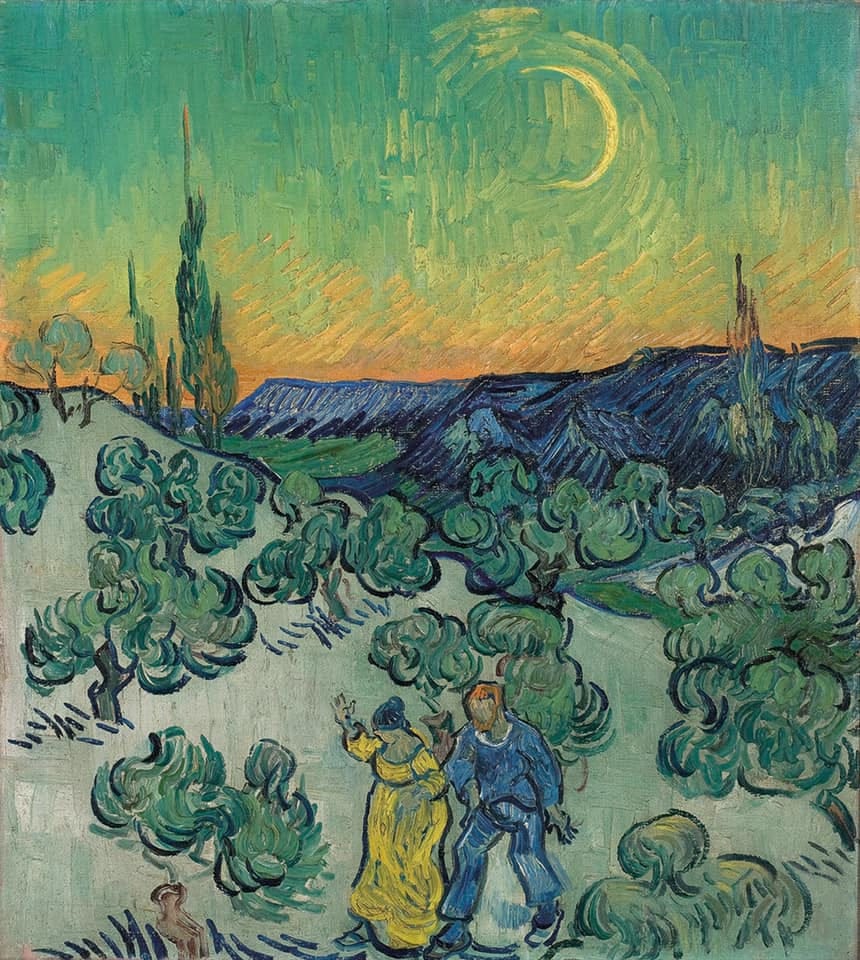
She’s incorporated Van Gogh's depiction of dusk, a lesser-known painting from his Saint-Remy period. She’s transformed it, harnessing the sculpture’s ominous steel surface, into a midnight sky illuminating fields and flowers with just a crescent moon.
Except, I was realizing, she did not work directly with prints of his work at all; her reproductions are crude compared with Van Gogh’s oils. The flowers, figures, plants, and moon are the work of her own hand, copied and shrunk, likely, with color Xerox technology, trimmed and layered to conform to the two-dimensional image of Serra’s sculpture. A still closer examination finds the collage touched up with chalky dabs of paint.
It’s a bit ominous, the dark steel sky, the way the one giant sunflower head is wilting, melting; it takes on a kind of nuclear fallout energy, for me, who was coming of age at this time in the 80s, this time of the Cold War.
The texture of that surface also had me seeing her working among all the scraps in the big window in her studio, among her precision paper cutter with the long handle, where she looked out over the parking lot off Crosby Street, before the luxury hotel went up that cost her most of that window.
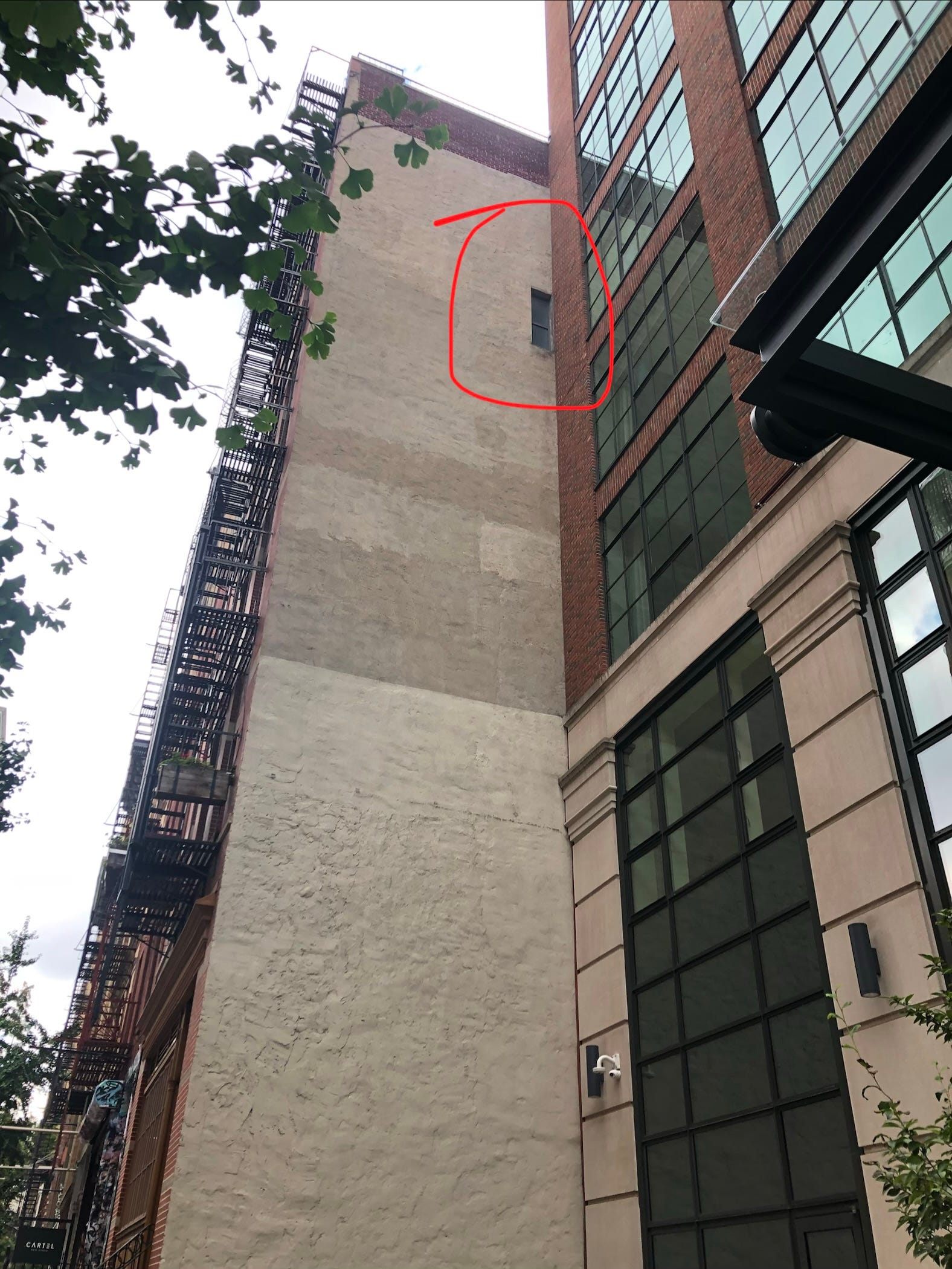
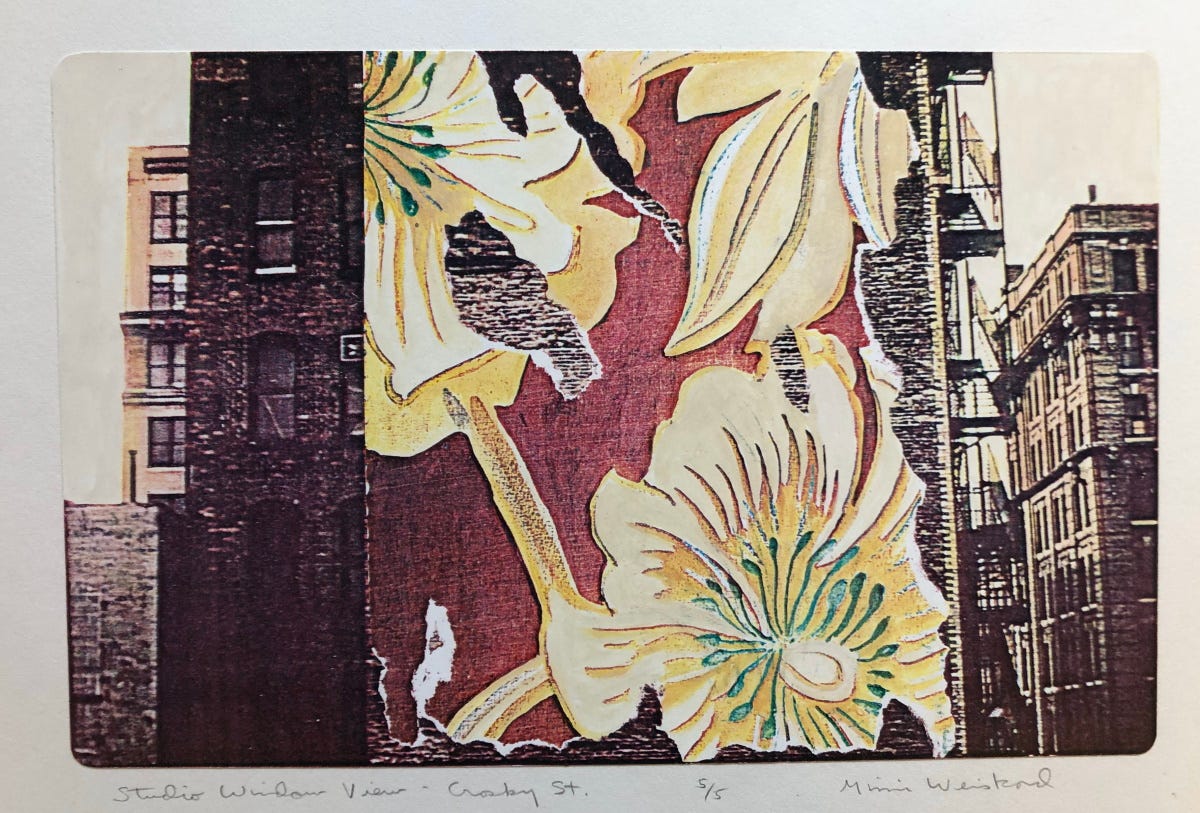
(Studio Window View, her floral mural proposal at the start of this post, was created before the hotel took over the parking lot.)
These layers of memory and meaning are all present on this single page drawn from a box. No wonder sorting and packing are slow going for me.
There’s also this: a few years before she submitted her Federal Plaza proposal, she’d begun incorporating emerging color Xerox technology into her work. To the astonishment of her children, she was interviewed for ABC Nightly News as a kind of pioneer (a very rare moment in the spotlight for my mother).
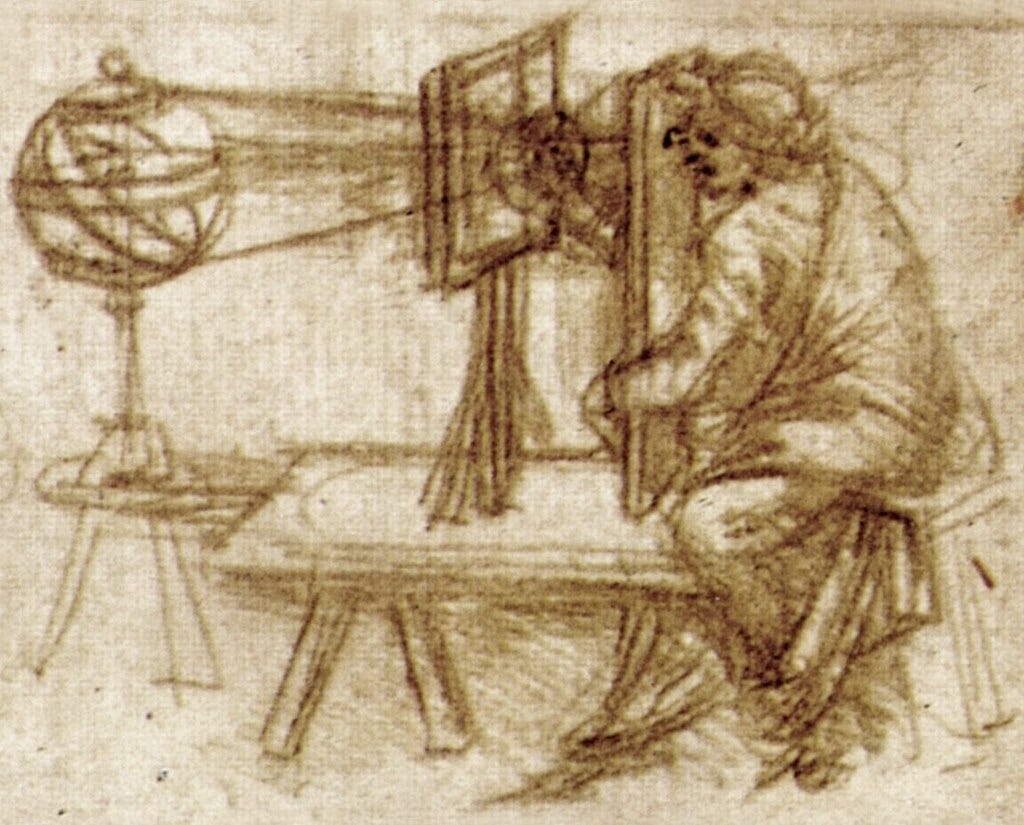
Thomas Hoving asked her what Leonardo da Vinci would have thought of the color Xerox machine. He brought up Da Vinci, no doubt, as just the quintessential Renaissance master.
My mother responded with more insight. “Da Vinci would have invented it,” she smiled. 1
My father eschewed the term “artist.” He’d furrow his brow and say he was a “painter,” not an “artist,” (punctuated with a bit of spittle), so dedicated was he to his medium.
My mother, on the other hand, was adamant about being an artist. She started out embracing oils, watercolors, and printmaking, had phases with sculpture, jewelry making, book binding, including a brief period incorporating color xerox. (She eventually regretted that work.) She loved all forms of art. She loved literature too. In the end, however, she returned to oils, a painter through and through.
I imagine my father working continuously now in a studio with northern light, his eyes restored, happily capturing the beauty of everyday heaven.
I imagine my mother roaming across the astral planes, hungry for the art lessons of all the ages, forever restless, an old soul never satisfied.
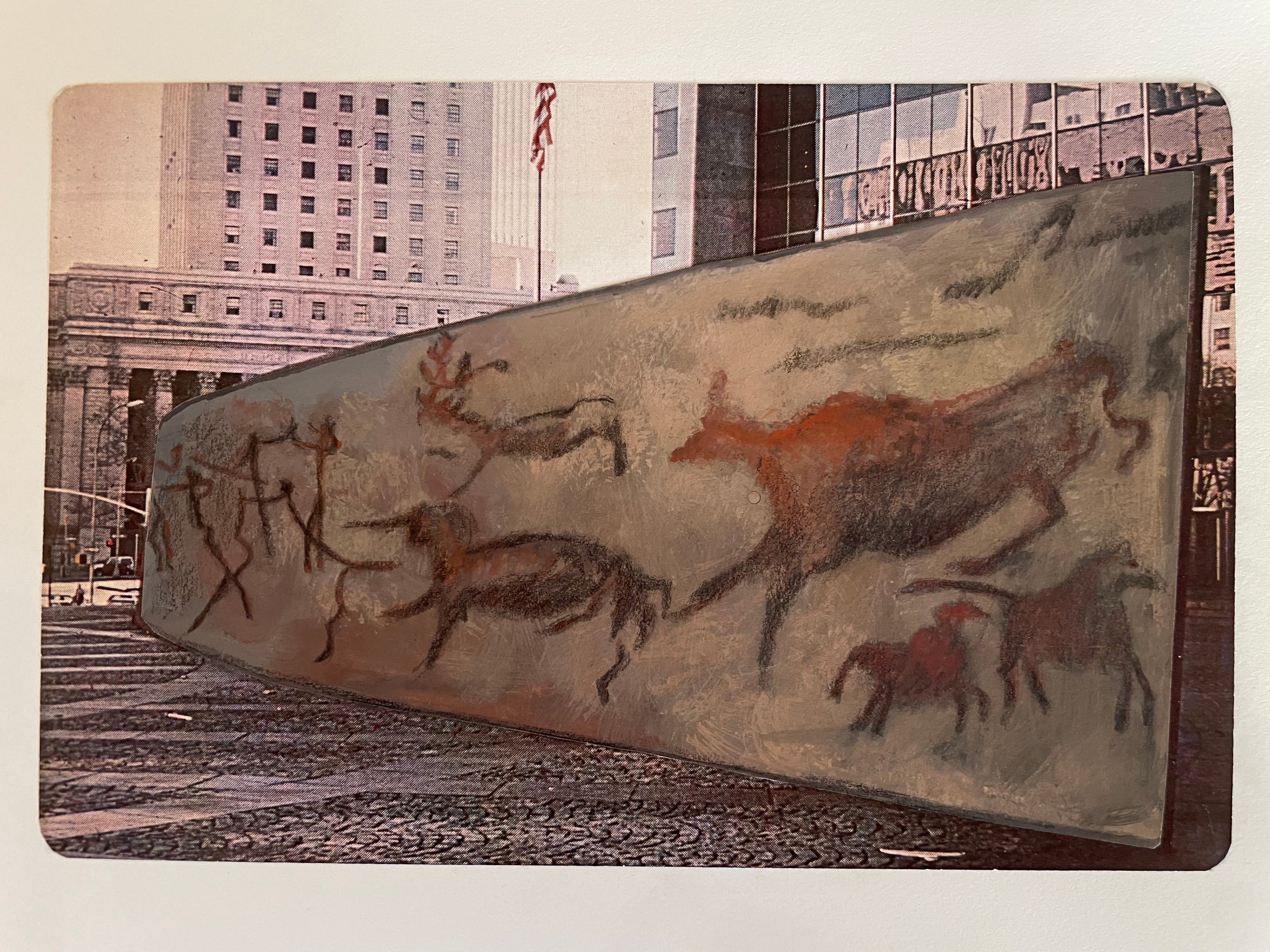
“In art, innovation is constant, nothing is untouched by it, and yet nothing already invented ever becomes obsolete” — Carter Ratcliff
Related posts:


But not AI. An artist invent generative AI to steal their work and make it available for, literally, mindless manipulation? Never.
Your mother’s proposed murals are extraordinary. If only!! Thanks for sharing and reflecting on them.
Love this! Mimi’s restless roaming kept her work cutting-edge and progressive. It’s so interesting to think of the contrast with your dad’s work.